
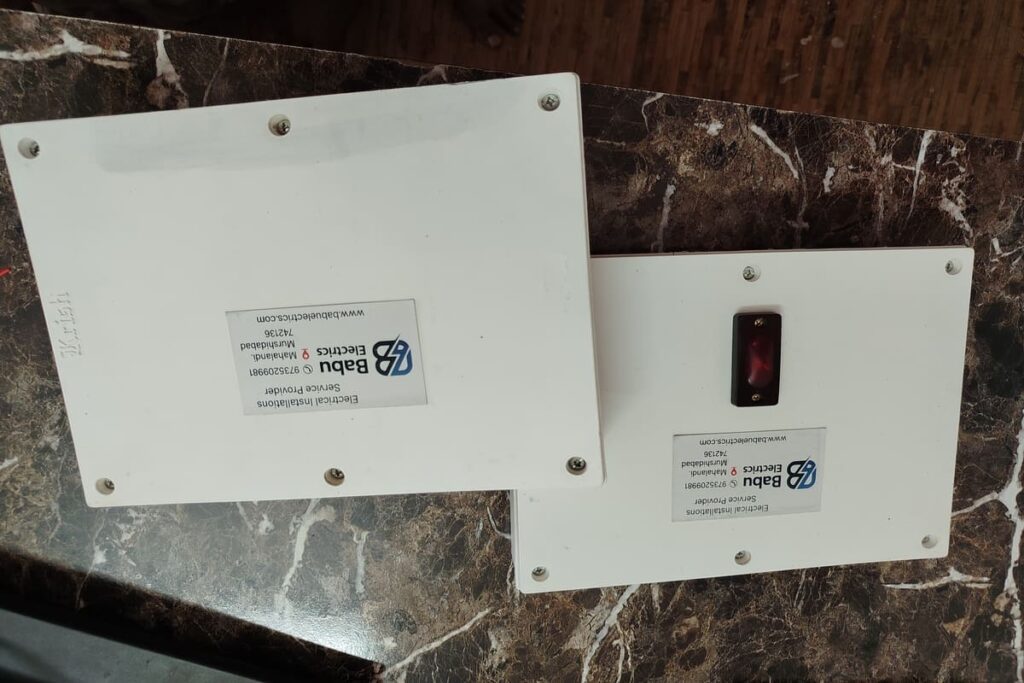
Babu Electrics has been providing top-class electrical installation services for more than 12 years. We are not just simple electrical service providers; we are problem solvers for common household electrical issues.
We understand very well that in daily life, especially in ordinary households in our country, people face many problems due to improper electrical systems and the unavailability of suitable devices. Because of this understanding and experience, Babu Electrics is always one step ahead of other service providers.
If you want to use any device that can reduce your stress, save your time, and work effectively according to your personal needs—whether at home or at any preferred place—we design and provide such solutions. Many of these solutions are not easily available in the market, especially those suitable for real daily-life problems. That is why, from the very beginning, we first inspect the customer’s site, understand the exact requirement, and then design a suitable device or system.
Common Problem in Rural and Semi-Urban Areas
In rural and semi-urban areas, we often see joint families where brothers live in the same house but are electrically separated. In many such cases, there is only one submersible pump, but multiple users want to operate it from their own individual electric meters whenever required.
I have seen that people face many difficulties while operating a single pump from different places. Most of the time, they pull temporary wires from their own houses and plug them into the pump every time they need water. Since water is essential for daily use, this practice becomes a total waste of time and labour, and it is also unsafe.
This situation deeply concerned me.
My Solution to the Problem
I told the customer that I would create a circuit so that they would not need to put in so much effort to start the submersible pump.
With this system:
- All brothers will have separate starters
- Anyone can start the pump by simply pressing a button
- When one person is using the pump, others cannot operate it at the same time
- Each user feels like they have their own submersible pump
- Electricity consumption is recorded on the individual meter
Water direction can be changed manually using a ball valve to supply water to the required tank. If needed, this system can also be made fully automatic. When the pump starts, an electric ball valve can automatically direct water to the selected tank.
The customer was happy with the manual option and said full automation was not necessary for him. I then designed and implemented this system in 2020, and since then it has been working very smoothly without any problems.
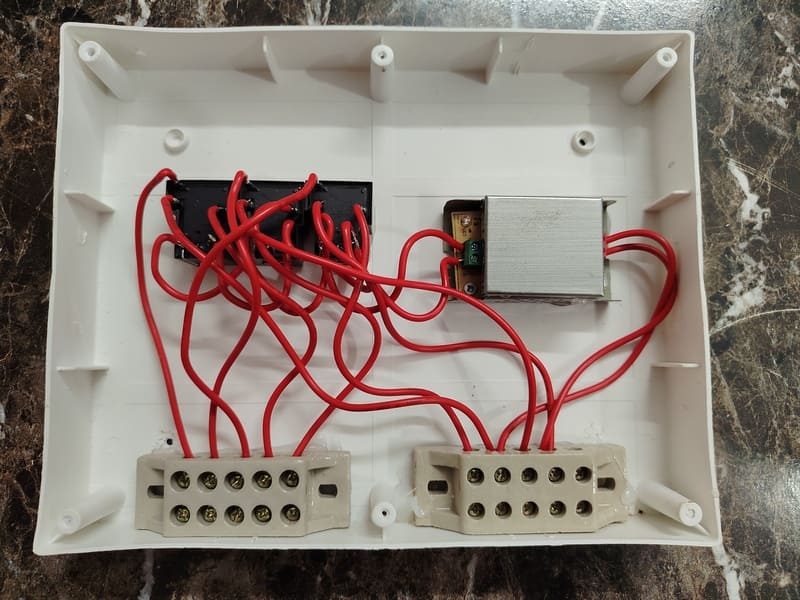
Required Components
To make this device, you will need the following items:
- One PVC box (8×10 size)
- Two pieces of 5-way HT connectors
- Three SPDT relays (12V, 20A recommended)
- Three pieces of 4148 zener diode or 4007 Schottky diode
- Around 3 yards of 1.5 sq. mm wire
- One 12V power supply
You can use a 10A relay, but it is not very strong. For long-lasting and reliable operation, I strongly recommend using a 20A relay.
Customers have been using this system for years, and it is still working perfectly without any interruption.
Basic Connection Procedure
After collecting all the components:
- Cut one side of the PVC box for the HT connector opening (placed at the bottom).
- Fix the HT connector using a glue gun.
- Place the relays and power supply inside the box one by one.
- Connect all three relay coils in parallel.
- Connect one diode in parallel with each relay coil.
- Carefully check the anode and cathode direction of the diodes before connecting to the power supply.
Relay Connections
- Connect all NC terminals of the SPDT relays to Motor Starter Panel No. 1 in R-Y-B sequence
- Connect all NO terminals to Motor Starter Panel No. 2 in R-Y-B sequence
- Connect all common terminals of the relays to the submersible pump output
- Finally, connect the power supply input to Panel No. 2’s red and blue wires
That’s it.
Now you can operate one submersible pump from two places.
If you want to control the motor from more than two places, you can simply add the same circuit again.
Future Expansion
This circuit is also suitable for full automatic operation. By adding an electric ball valve, you can control water flow direction automatically without manually switching valves.
Final Words
If you have any questions regarding this circuit or its operation, please comment on this post.
You will definitely get a reply.
Thank you.